
The egg float test: what it tells you and what it doesn’t
The bowl-of-water test is old and it works: in a few seconds it shows whether an egg is fresh or old. The common mistake is throwing out every egg that floats. Floating is about age, not about the egg having gone bad.
Here is how to do it, how to read the result and what to do next.
Is an egg that floats bad?
Not necessarily. A fresh egg sinks and lies on its side; an old egg stands on end or floats, because it loses water through the shell and its air cell grows. Nebraska Extension says a floating egg may be perfectly safe to use. To know for sure, crack it into a separate dish and smell it.
The float test mostly measures the age of an egg: the air cell gets larger as water evaporates through the shell. Source: University of Wisconsin–Madison Extension.
| What the egg does | What it means | What to do |
|---|---|---|
| Sinks and lies flat | Fresh egg | Use as usual |
| Sinks but stands on end | Older egg | Good for hard-boiling and peeling |
| Floats | Old, not necessarily bad | Crack into a dish and smell before using |
- Fresh: lies on the bottom
- Older: stands on end
- Old: floats. Crack and smell it first
How to do the egg float test
Step by step 1: Use a deep container
Take a tall glass or a bowl and fill it with cold tap water, deep enough to cover the egg with room to spare.
Step by step 2: Lower the egg gently
Place the whole, uncracked egg in the water and wait a few seconds until it settles.
Step by step 3: Check its position
Lying on the bottom, standing on the bottom or floating: compare it with the table above.
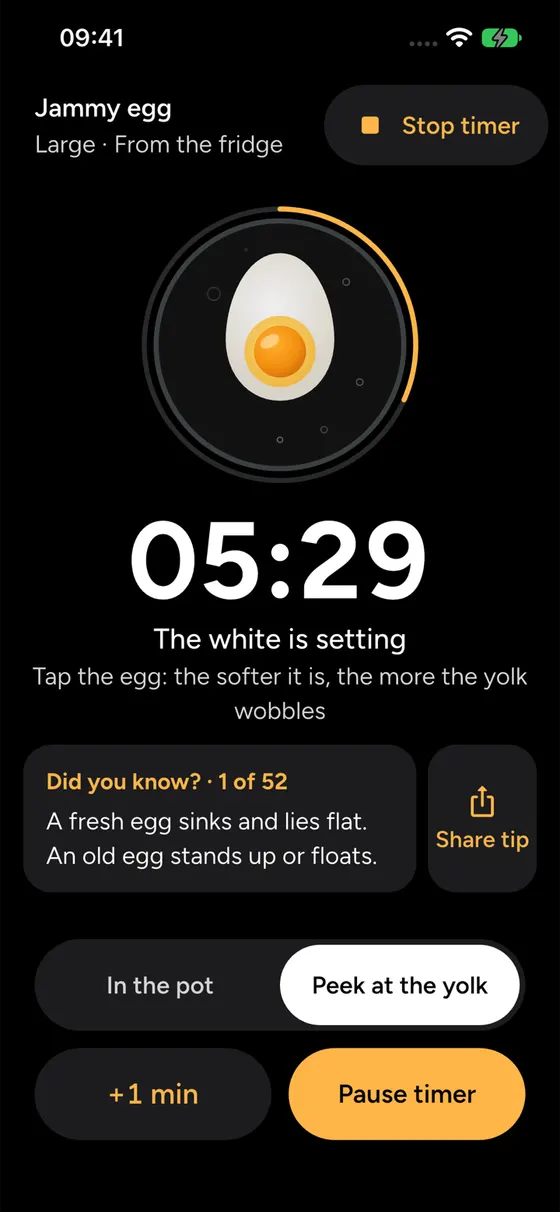
In the Timertok app: "Did you know?" card: a fresh egg sinks and lies flat; an old egg stands up or floats.
Step by step 4: If it floats, crack and sniff
Crack it into a separate dish, away from other ingredients. If it smells bad, throw it out.
Step by step 5: Dry and refrigerate
Dry the eggs that passed and put them back in the refrigerator.

Is the egg float test accurate?
It is accurate for age, not for spoilage. A fresh egg sinks and lies flat, an older one stands on end and an old one floats, because its air cell grows over time. Nebraska Extension says a floating egg may be perfectly safe to use. If in doubt, crack it and smell it.
3 outcomes in the glass: lying flat (fresh), standing on end (older) and floating (old). Source: Iowa State University Extension and Outreach.
Did you know?
Why do old eggs float?
Water inside the egg slowly evaporates through the shell, and the empty space at one end, the air cell, gets bigger. Iowa State University explains that an egg floats once that air cell has grown enough to make it buoyant. That is why the result is about age.
Can the float test detect salmonella?
No. The University of Wisconsin–Madison says the test mostly measures an egg’s age; it isn’t designed to find bacteria. A fresh egg that sinks still needs safe handling, and the FDA advises cooking eggs until the yolk and white are firm for people at higher risk.
Is there any upside to older eggs?
One: they peel better after cooking. Iowa State University says eggs 7 to 10 days old make better candidates for hard cooking, because the white’s pH rises and it sticks less to the shell.
Sources
- Egg Safety Q&As. Iowa State University Extension and Outreach, March 31, 2026.
- No Bad Eggs! Internal Egg Quality. University of Wisconsin–Madison Extension.
- Is an egg that floats still fresh?. Nebraska Extension.
- What You Need to Know About Egg Safety. U.S. Food and Drug Administration (FDA), March 5, 2024.
Every source was opened and checked by Equipe Timertok on .